
Monster Hunter Wilds asks new hunters to commit to one of fourteen wildly different weapon types before they've even seen a real monster fight, and that choice shapes your entire early game. Pick something too punishing and every hunt feels like a coinflip; pick something forgiving and you'll actually learn monster patterns instead of just panicking through them. Here's how to choose, and how to approach your first hunts once you're in the field.
Why Sword and Shield is still the best starting pick
Sword and Shield has been the recommended beginner weapon across multiple Monster Hunter generations, and Wilds doesn't change that. It's fast, has a wide variety of combo "outs" — meaning you're never locked into a long animation you can't cancel out of — and can block incoming attacks at the cost of stamina rather than committing to a full dodge every time. Crucially, Sword and Shield lets you use items and potions while your shield is raised, which is a massive quality-of-life advantage: you can heal mid-fight without fully disengaging, something almost no other weapon type allows as cleanly.
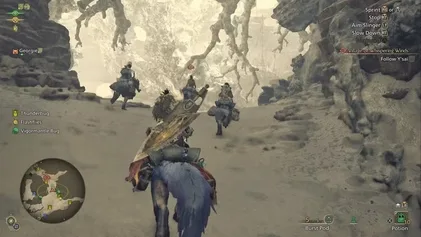 Image credit: Capcom (official screenshot, via Wikipedia) - verify rights before publication
If your priority is learning monster attack timing and positioning without constantly restarting hunts from a cart, Sword and Shield is the safest on-ramp into the game's combat.
Other strong beginner-friendly options
Not everyone gets along with Sword and Shield's playstyle, and a few alternatives are worth considering depending on your instincts:
- Dual Blades — faster and flashier than Sword and Shield, with strong sustained damage, but slightly less forgiving since you commit harder to extended combos. A good pick if you liked Sword and Shield's mobility but want more damage output.
- Lance — built around guarding and counterattacking rather than dodging, which makes learning monster attack patterns inherently safer since you're rewarded for standing your ground correctly instead of punished for bad dodge timing.
- Long Sword — rewards precise, well-timed attacks with a counter mechanic, and is less punishing overall than a badly-placed Great Sword swing, but demands more pattern recognition than Sword and Shield.
The general rule for a first serious weapon: pick something that lets you recover from a mistake rather than one that locks you into a long commitment animation the first time you misjudge a monster's attack.
Get used to the Seikret before your first big hunt
Wilds' mounted companion, the Seikret, changes traversal and combat pacing significantly compared to older entries — it lets you sprint across terrain quickly, auto-navigate toward quest objectives, and even attack while mounted in some contexts. Spend time in early quests just getting comfortable calling your Seikret, dismounting into combat cleanly, and using it to close distance on a fleeing or enraged monster rather than chasing on foot, which wastes stamina and time.
Practical tips for your first real hunts
- Study monster tells before engaging aggressively. Most large monsters in Wilds telegraph their big attacks clearly — a roar animation, a tail raise, a stance shift. Spend the first minute of any new monster fight watching rather than attacking, especially the first time you face that species.
- Bring Mega Potions and antidotes, not just base healing items, once you have the materials — status effects (poison, blast, paralysis) chip away at a hunt far more than raw damage if left unmanaged.
- Target the head or the monster's weak part for your weapon type, not just whatever's closest. Sword and Shield in particular is good at cleanly hitting specific parts thanks to its precision and mobility.
- Don't panic-roll into a corner. A common beginner death spiral is dodging repeatedly in the same direction until you run out of room — vary your dodge direction and use terrain to your advantage.
- Cart once, learn, cart less. Fainting (carting) three times ends a hunt, but each cart teaches you a monster's most dangerous move. Treat your first cart on a new monster as information, not failure.
A simple first-hunt checklist
- Weapon: Sword and Shield (or Lance if you prefer guarding over item use).
- Consumables: Potions, antidotes, a couple of traps once unlocked.
- Approach: watch the first attack pattern before engaging, use the Seikret to reposition rather than sprint on foot.
- Goal: focus on not carting more than once on your first attempt at any new monster — clean kills come later.
 Image credit: Capcom (Steam store assets) - verify rights before publication
Monster Hunter Wilds rewards patience far more than raw reflexes early on. Start with a weapon that lets you make mistakes safely, learn to read a monster before you fight it aggressively, and the game's steep-looking learning curve flattens out much faster than it first appears.

Jordan writes the guides that get you unstuck — build orders, boss patterns, and progression routes tested step by step before publishing. A former competitive player turned full-time guide writer, Jordan has a soft spot for punishing difficulty settings and a spreadsheet for every game with a skill tree. Readers trust the guides because Jordan actually finishes them first.

Comments
No comments yet — be the first to share your thoughts.